
Le Tourneau Logistical Car VC-22 Sno-Freighter, 1954 The Sno-Freighter is a one-of-a-kind land vehicle designed by LeTourneau Technologies for Alaska Freight Lines in the 1950s. During that decade, Alaska Freight Lines won the contract to transport construction material to build the Distant Early Warning Line (DEW) in far northern Alaska and Canada. At the time, no roads crossed the Arctic Circle in North America, there were almost no runways for air transportation, and the polar ice cap prevented seaborne transport. LeTourneau had built a series of prototype "land trains" for use in roadless environments, and Alaska Freight Lines contracted the company to build a special model for cold-climate transportation on January 5, 1955. |
|---|
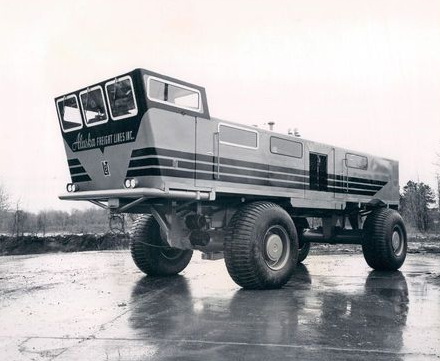
Le Tourneau Logistical Car VC-22 Sno-Freighter, 1954 Using parts from its previous land trains, LeTourneau manufactured the Model VC-22 Sno-Freighter by mid-February and shipped it to Alaska. The "locomotive" of the Sno-Freighter contained two Cummins diesel engines with 800 combined horsepower. These engines drove 24 electric motors (one for each wheel on the locomotive and trailing cars). The Sno-Freighter proved a success in Alaska, becoming one of the first wheeled vehicles to drive from Fairbanks, Alaska to the Arctic Ocean. Its cost prevented further models from being deployed, but the original model moved goods to DEW sites across Alaska and Canada until they were completed. After that, it transported supplies for the early exploration of the North Slope's oil reserves. Rising maintenance caused it to be replaced by the slower but more reliable Cat trains—sleds or sledges drawn by one or more tractors. |
|---|
On 15 April 1954 the company demonstrated VC-12 to the US Army Transportation Research and Development Command, or TRADCOM, proposing that the system would be useful for logistics operations in the arctic if equipped with more wheels.
TRADCOM offered funding to create the TC-264 Sno-Buggy, which had eight huge 120-inch (3.0 m) rubber tires, arranged in pairs and driven by four motors powered by a single Allison V-1710 engine running on butane.
The resulting vehicle has an enormous amount of tire area to vehicle weight, allowing it to float on the tundra and snow. First unveiled in June 1954, TC-264 Sno-Buggy, was sent to Greenland for testing.
Alaska Freight Lines, of Seattle, had contracted with Western Electric to provide 500 tons of equipment to the DEW stations being built in the Alaska sector. Hearing of the VC-12 , on 5 January 1955 they signed a contract with LeTourneau for the construction of the VC-22Sno-Freighter.
The contract called for a single locomotive and six cars able to haul 150 tons, cross rivers up to 4 feet (1.2 m) deep, cut through snow drifts and operate at temperatures as low as -68 degrees F. The locomotive provided AC power from 400-hp Cummins NVH-12 engines, powering its own four wheels and the five four-wheeled trailers, forming a 274-foot-long (84 m) train.
Since the VC-22 was based almost entirely on existing parts from their 6x6 vehicles, even the tires, the company was able to deliver it with surprising speed.
It was completed on 17 February 1955, painted, and then sent to Alaska on the 21st. The vehicle served well throughout 1955, but in the second season of use a fire consumed the locomotive's power generation section and the remains were pulled out of Canada.
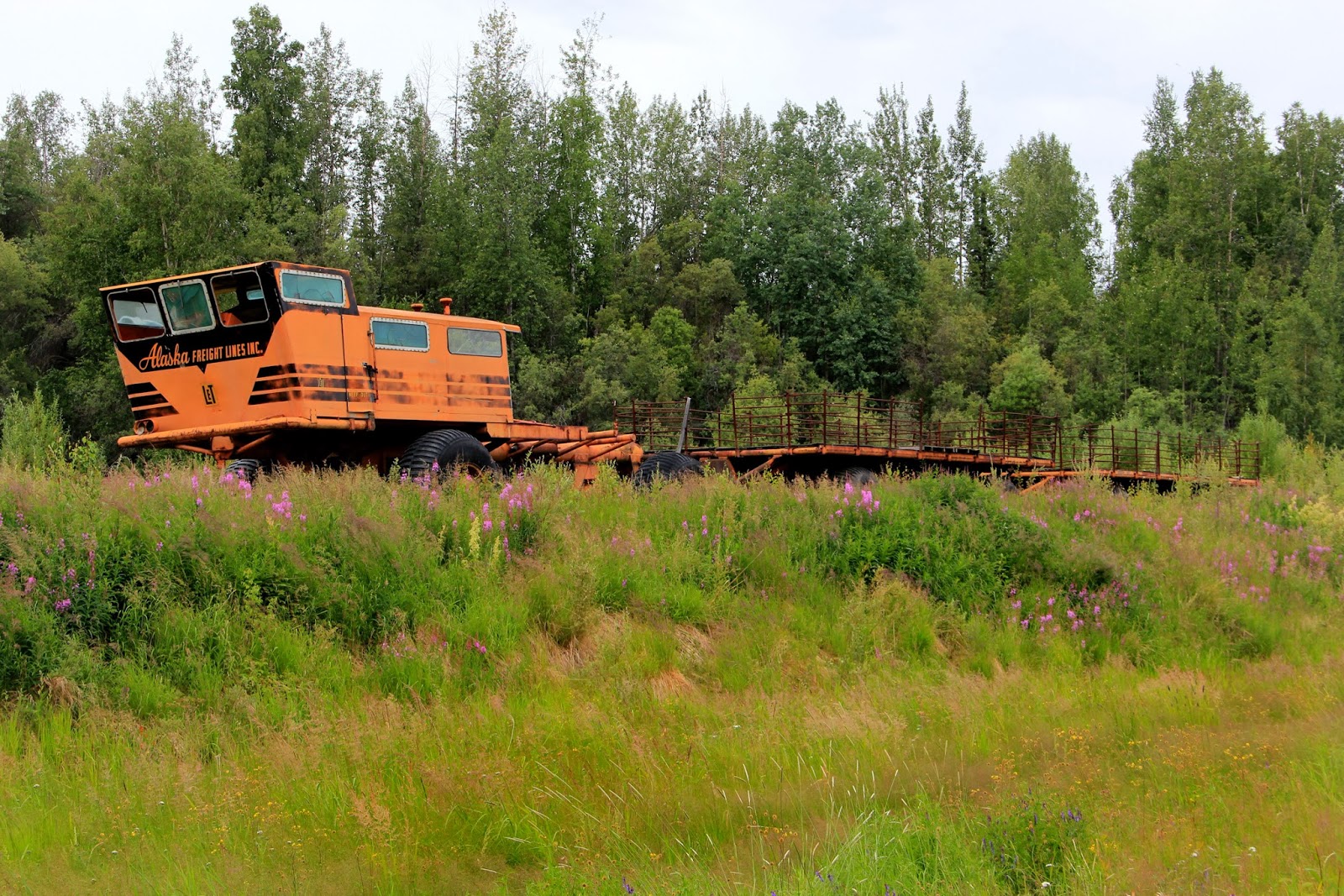
When Alaska Freight Lines's contract with Western Electric ran out it was soon left to rot. Today it sits abandoned outside Fairbanks, Alaska near the Steese Highway.
On their own initiative, LeTourneau took the basic VC-22, changed the engine to the 600-hp VT-12, and changed the trailers to side-dumping bins to produce a the Side-Dump Train. The six-wheeled locomotive also had its own bin, and could operate independently. Completed in October 1955, the company was still under the moratorium period and could not sell it for earthmoving, and the train saw no orders.
| Внедорожные транспортные средства (Land Locomotion – Mechanical Vehicle Mobility LL-MVM) Home |